
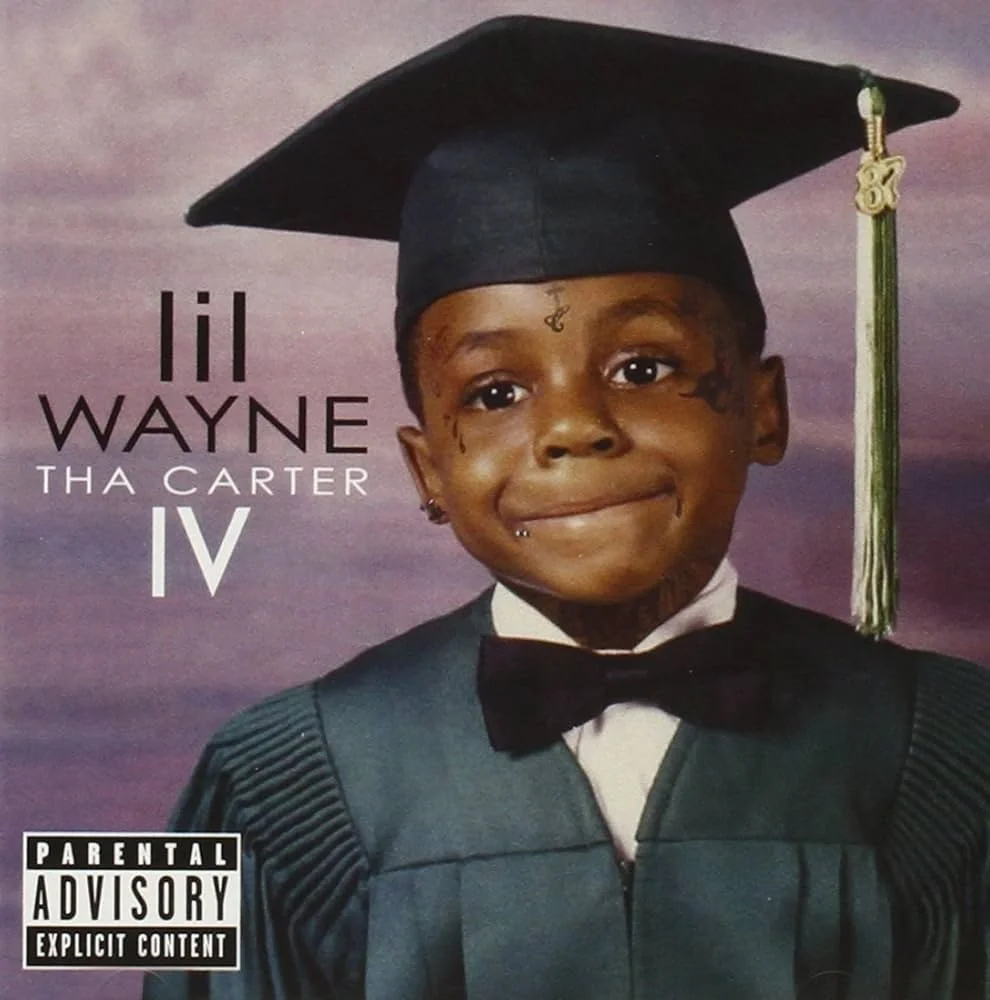
Revisiting: Tha Carter IV
10/10—NEAR PERFECT
Written by Blake P
ZERO AI WAS USED IN THE CREATION OF THIS POST
When the stakes couldn’t have been any higher for his career and the future of Tha Carter albums, Lil Wayne met the moment in an unprecedented way. Firing on all cylinders, he delivered the greatest installment of an iconic series, and arguably his greatest studio album of all time.
Before Lil Wayne and Tha Carter fans jump down my throat, just hear me out. If this isn’t Lil Wayne’s best album, what is it? Tha Carter I? Too early in Wayne’s career, he was still finding his footing. Tha Carter II? You could make a case…Wayne really showed out on C2 and began to make a name for himself, but it leaves some to be desired. Rebirth? Half of Lil Wayne fans pretend this album didn’t even happen; despite the fact it has actually aged decently. I Am Not A Human Being or I Am Not A Human Being II? A few 6/10 albums with timeless singles we still listen to today, but not a complete project to write home about. Free Weezy Album was bogged down but the weird Tidal Only release and later sample issues when cleared to have a full release. Funeral? Forgettable. C5? Great album, one of his best, but is bloated and a lot could have been left out. I kind of consider this the Lebron-Lakers era of Lil Wayne. C6? Don’t get me started on whatever the fuck that was.
The only album that you could make a case for being better than Tha Carter IV is its predecessor, Tha Carter III. It is the only argument I will tolerate, and the only album I used to ever use when defending the greatness that is Lil Wayne. The problem is Tha Carter III faced several issues leading up to and even after it’s release that have hindered the overall quality of the album. Starting with five songs that were originally supposed to be on the album leaking shortly before the release, requiring them to be scrapped from C3 and later released as “Tha Leak.” On top of this, there was a copyright dispute with the song “Playing With Fire” from ABKCO Music which owns The Rolling Stones’ music catalog, stating the song was too similar to the Rolling Stones song with the same name. This led to another great song being removed from C3 and being replaced with “Pussy Monster”, which has a case for being the worst Lil Wayne Song of all time.
Despite those issues, off the back of Tha Carter III, Lil Wayne rose to a level of hip-hop superstardom that had arguably never been seen before, save maybe Eminem in the early 2000s. He was everywhere. Seriously, everywhere. Go ask literally any millennial from the ages of 30-38 and see what they have to say about Lil Wayne. There’s a high chance they spew into some story about some party they were at where some Lil Wayne song was playing, or something to that degree. Hip-hop was dominating the music world, and Lil Wayne was front and center, releasing mixtapes and being featured on every song from every genre you could possibly imagine. Think of what Drake did before he did it. It was a culturally unifying experience. My dad knew who Lil Wayne was. I know you don’t know him so it’s hard to grasp how insane that is, but it’s insane. If I said the name “Lil Uzi Vert” around my dad now he would probably have me institutionalized.
Pair this with the fact that in between the release of C3 and C4, Lil Wayne who was the king of mixtapes, released his greatest mixtape ever and arguably his greatest all around project, No Ceilings, in 2009. This showed Wayne come up a level from C3 and demonstrate, remarkably, that C3 wasn’t even his peak. Throw in a year long jail sentence, and another iconic mixtape “Sorry 4 Tha Wait” (dropped to hold people over from the delays C4 was taking), and a handful of singles to top the charts, and you had a hype train gaining monumental speed.
I say all this to try to explain just how much pressure Lil Wayne was under when it came to releasing Tha Carter IV. From a hip-hop standpoint, no album had carried this much hype into its release in a long, long time. Hip-Hop was mainstream, it was the new cultural norm, and all eyes would be on Lil Wayne’s continuation of Tha Carter, the series that etched him into hip-hop’s Mount Rushmore. When it comes to people in the limelight, no matter their chosen field, we love nothing more than to build people up just to tear them down. It is so unlikely that people live up to the unrealistic expectations we set for them, and almost unheard of that they exceed those expectations. Nevertheless, Wayne managed to do it with Tha Carter IV in literally every single aspect. From lyrics to flow, from features to production, it takes a leap forward and outperforms all its predecessors and has continued to stand the test of time.
Upon release, Tha Carter IV gained mixed reviews, but we don’t care about that, because fuck the likes of Pitchfork, Rollingstone, and all those like them. You nerdy pricks would find something wrong with 36 Chambers. Commercially, however, C4 did exactly what it was expected to do. At this point, streaming wasn’t what it is today, and we were throwing down hard earned money on albums in the form of hard copies or digital downloads. On August 29th, 2012, Tha Carter IV released. It sold 964,000 copies in its first week, in it’s second week another 219,000. By February of 2012, the album had gone triple platinum, selling 3.5 million copies worldwide. Fast forward to September 2020, C4 was five times platinum, selling over 5 million copies. IN A PHYSICAL MEDIA ERA. For anyone under the age of 26, you need to understand what an insane feat this was.
Tha Carter IV became an anthem for high school and college kids all over America, and some overseas. It was all we listened to, all we talked about. Watch The Throne, releasing the same week, stuck around for a while but was quickly lapped, and pushed to the side to make room for what many consider to be their GOAT. The album starts off with a run of feature-less Wayne classics, demonstrating Wayne staples of similes, metaphors, and simplistic but dominating beats that rattle cars and stick in your head. On “Intro”, he packs in a string of similes in the beginning of the song just to get you acquainted if you weren’t familiar. “Suicide note, suicide doors. I put in overtime, like a tied score.” Wayne raps, continuing “Tinted windows bitch, that mean mind yours. And the weed loud, like a lion’s roar.” He settles into C4 the way we had grown accustomed to, sucking you in from the first lighter flick.
We ride in to Blunt Blowin’, highlighted but a drumline-esque beat in the beginning, building to the inevitable drop of chest rattling bass when the chorus comes in. And while the chorus doesn’t make a ton of sense lyrically, you forget about it completely because of how hard the rest of the song is. “I’m a bad motherfucker cause the good die young. Everybody selling dreams, I’m too cheap to buy one.” Then to MegaMan, the first rapid fire rap song of C4 where it feels like Wayne isn’t taking a breath. No chorus, no features. Bars only. We arrive at the first single for C4, “6 Foot 7 Foot”, and I’m going to say it. This is just a better “A Milli.” Equally iconic production but more memorable flow and lyrics, 6 Foot 7 Foot makes you forget about the “just okay” Cory Gunz feature, mainly because of one of Wayne’s most iconic lines ever: “Paper chaser tell that paper ‘Look I’m right behind ya’, Bitch Real G’s move in silence like lasagna.” Only Lil Wayne man…only Lil Wayne.
Nightmares of the Bottom slows things down but speaks prominently on issues like Wayne’s jail sentence and his relationship with Mack Maine. He also gives us a classic Weezy “I just had a bowl of riches, and a cup of wealth, and the F is for Fuck Yourself.” She Will brings my personal favorite production to the album, a haunting yet rhythmic beat with heavy drums, topped with an iconic Drake chorus reminding us now, but demonstrating to us then what an iconic duo these two make. The middle of the album sees an unexpectedly enjoyable T-Pain feature in “How to Hate”, a hidden Andre 3000 feature in “Interlude”, and a jarring beat but enjoyable Rick Ross feature in “John”, another single from the album.
Wayne goes back to a solo track with “Abortion”, a metaphor for rappers in the belly of the rap game, and how they can be tossed aside and forgotten about at a moments notice by fans that hold them powerless to their own success. The theme is underscored by one of my favorite lines of the album “Woke up this morning, dick rock hard. Ash my blunt in my Grammy award.” Then, we get a shockingly beautiful John Legend chorus in “So Special”, which is clearly supposed to be a sex song but goes so incredibly hard I kind of forget about that. “Baby won’t you spend the night, darlin’ I don’t want to wake up and you are not by my side,” Legend sings, with something between passion and heartbreak. Wayne follows it up with “Love be the pilot, but it’s kamikaze. Body language, girl let’s talk about it.” It’s truly a great sadboi/love sick anthem. To be honest, it pairs perfectly with what could be the only possible knock on the album, “How To Love.” Here’s the thing though, I think I was too hard on “How to Love.” It’s really not that bad. It has a time and a place, I just don’t think it’s on this album.
The final three songs tells you Mr. Carter isn’t letting off the gas any time soon. Starting with a poignant “President Carter” where Wayne slows things down and speaks to the youth of America, or maybe their parents. At the end of the song, he sends it off with a final message, which could’ve been used to end the album: “Gorillas in suits, the holy war, the spiritual troops. Fighting over the mythical truth, drowning in the political soup. They shoot missiles and nukes, taking out such a pivotal group. The body count is the physical proof, and they thought drugs were killing the youth.”
Seeing as almost no one came under as much fire as Lil Wayne for their drug use and what it could’ve been doing to the youth of America, it’s a statement from Wayne, “maybe there are other things you should be worried about.” Second to last, “It’s Good” features insane verses from Jadakiss, Drake, and Wayne. At the time, this was rumored to be a diss song towards Jay-Z, linking back to comments made by him about Birdman, leading Wayne to rap “Talkin’ bout ‘baby money’? I got your ‘baby money.’ Kidnap your bitch get that ‘how much you love your lady money.’” The song drew so much attention for the potential feud, Jadakiss tweeted “they sent me the beat before any verses were recorded, don’t involve me in this.” I’m not sure we ever got the bottom of the meaning of the song, but it’s worth ignoring to hear Drake angrily rap for the first time in his career, rattling off “Rikers Island on this flow, eight months for that pistol, but at least they had some bad bitches working in that shit hole.” In reference to Wayne’s prison sentence.
The album ends with a posse cut, “Outro”, bolstering features from Bun B, Nas, Shyne, and Busta Rhymes on the same beat used in “Intro” and “Interlude.” A perfect call back to early in the album and a perfect ending to a scorching face melting hip-hop ride where everyone in the song, just like everyone in the album, raps as if their life depends on it.
When I decided to write this, I listened to this album over, and over, and over again. I really listened, I tried to nitpick and critique and find flaws. It was so difficult. I don’t know if it’s nostalgia. Maybe like a detective, I’m too close to the case. I remember, so vividly, moments in my life listening to this album. It’s laced in memories I’ll hold with me my entire life. A theme song or a score to the movie that is my childhood. So I can’t say I’m looking at it objectively, because I’m not. But, nevertheless, even the things you hold dear when you were young mostly fade, eventually, with time. Tha Carter IV doesn’t. It’s a testament to arguably the greatest rapper ever, depending on who you ask. There’s no skips, there’s no bad beats, there’s no bad verses. The one thing you can knock it for is a song that simply feels out of place. And that alone is not enough to drop a point, or even half a point off the album. If you even semi-enjoy Lil Wayne, you simply have to love Tha Carter IV, because it is everything that makes Wayne who he is. Wrapped up, with a bow and a ribbon. It’s essentially a personification of everything that makes him so great. All the dials are on eleven and the speakers aren’t blowing out.
We may never get a hip-hop album like this again. An album that showcases the absolute best from an iconic artist. One that topped the charts and has this level of longevity. I think C4 worked then, I think it works now, and I think it will work forever. It is Lil Wayne’s magnum-opus, a snapshot of hip-hop in a particular point in time, both a testament to and a send-off for a very particular era of rap music. I know every word, and on every listen, I can’t get them out of my head. Tha Carter IV shows that rap is Wayne’s domain. No one does it like him, very few do it better. Nothing changed from Tha Carter I to Tha Carter IV, and nothing’s changed from Tha Carter IV to now. We are in the presence of greatness.
“C4, Mr. Carter’s home.”